
A few years ago, many small businesses got by with a phone number and a social media page. In 2026, a website is part of how people decide where to buy, eat, study or get treated. Before they call you or walk in, they search.
This guide looks at the latest numbers on how people use the internet and search. It then explains, in plain words, ten reasons why your business needs its own website now.
The world online in 2026: the numbers
| What | Number | Source |
|---|---|---|
| People using the internet | More than 6 billion | DataReportal, Digital 2026 Global Overview |
| People using social media | 2 in 3 people | DataReportal, Digital 2026 |
| Google’s share of searches worldwide | 91.05% (October 2026) | StatCounter |
| Web traffic from phones | 59.9% (October 2026) | StatCounter |
| Consumers who read reviews for local businesses | 97% | BrightLocal, Local Consumer Review Survey 2026 |
| Consumers who check the website after positive reviews | 54% | BrightLocal, 2026 |
Three things stand out.
- Your customers are online. More than 6 billion people use the internet. Whoever your customers are, they are in that number.
- Google is the front door. About 91 out of every 100 searches worldwide go through Google. If you do not appear there, you are missing from the place where people look.
- Most visits happen on phones. Six in ten web visits come from a phone. Your website has to be fast and easy on a small screen.
Ten reasons your business needs a website
1. People search before they buy
Whether it is “bakery near me”, “best dentist in [city]” or “accountant for small business”, people type it into Google. The results show businesses with a website and a Google Business Profile. Without a website, you are competing with one hand tied.
2. Your website is open 24 hours a day
Your shop or office closes at night, but questions come at all hours. A website shows your services, opening hours and location at midnight just as well as at noon. Customers can decide before you even wake up.
3. It answers the same questions for you
Most businesses answer the same questions every day. What do you offer? Do you deliver? Where are you? When are you open? A clear website answers all of these, so your phone rings for orders, not for directions.
4. People check you before they trust you
According to BrightLocal’s 2026 Local Consumer Review Survey of 1,002 US adults, 97% of consumers read reviews for local businesses, and after reading positive reviews, 54% go on to check the business’s website. People check before they trust. A professional website with real photos, real reviews and a clear address makes that check easy.
5. You own it
A Facebook page or Instagram account belongs to the platform. Accounts get hacked, restricted or locked, and rules change without warning. Your website and your domain name are yours. If a social account has a problem, your customers can still find you.
6. You can reach customers beyond your street
A website lets people in other cities, and other countries, find you, order from you or contact you. A small business with a good website can serve customers it would never meet in person.
7. Enquiries and orders become faster and cleaner
A contact form, a booking request or a chat button on every page turns a visit into an enquiry in one tap. For shops and restaurants, each product can have a button that opens WhatsApp with the order already written. Read how this works in restaurant websites with WhatsApp ordering.
8. Your Google Business Profile works better with a website
A Google Business Profile shows you on Google Maps. Linking it to a website gives Google and customers more information: your full services, photos and answers. Both together are stronger than either alone.
9. AI search reads websites
More people now ask ChatGPT, Google’s AI Overviews and other AI tools for recommendations. These tools build their answers from information on websites. A website with clear, specific pages about your business gives them something to read and cite. A social page often does not.
10. It keeps working for years
An ad stops the moment you stop paying for it. A website keeps answering questions and bringing enquiries for years, and you can start small and grow it later. See what decides the cost of a website.
Which businesses need a website most?
Every business benefits, but these feel the difference first:
- Restaurants, bakeries and cafes: menus and party orders. See websites for restaurants.
- Clinics and labs: doctors, timings and services. See websites for clinics.
- Schools and academies: admissions and fee structure. See websites for schools.
- Shops and online sellers: a catalogue or full online store. See websites for retail shops.
- Service firms and consultancies: trust for bigger clients. See websites for recruitment firms and consultancies.
What a good business website should have
- Your services or products, explained clearly
- Real photos of your work, shop or team
- Your address, map, opening hours and phone number
- A contact or chat button on every page
- Customer reviews
- Fast loading on phones and computers
- Your own domain name, registered in your name
- Google Search Console and a Google Business Profile, set up from day one
“But my business does not need a website”
“All my customers are local.” Local customers search too. Someone who types “near me” is looking for a business close to where they are standing, and that is exactly your customer.
“I already have a Facebook page.” Keep it. Social pages reach followers; a website is what people find on Google and what you fully own. Read Facebook page or website for a side-by-side comparison.
“It is too expensive.” Start small, with only the pages you need. A website keeps working after you stop paying for ads.
“Nobody will visit it.” A website with no Google setup and no links will get few visits. Set up properly, linked from your Google profile, emails and social posts, it becomes the place where all your channels point.
Real examples
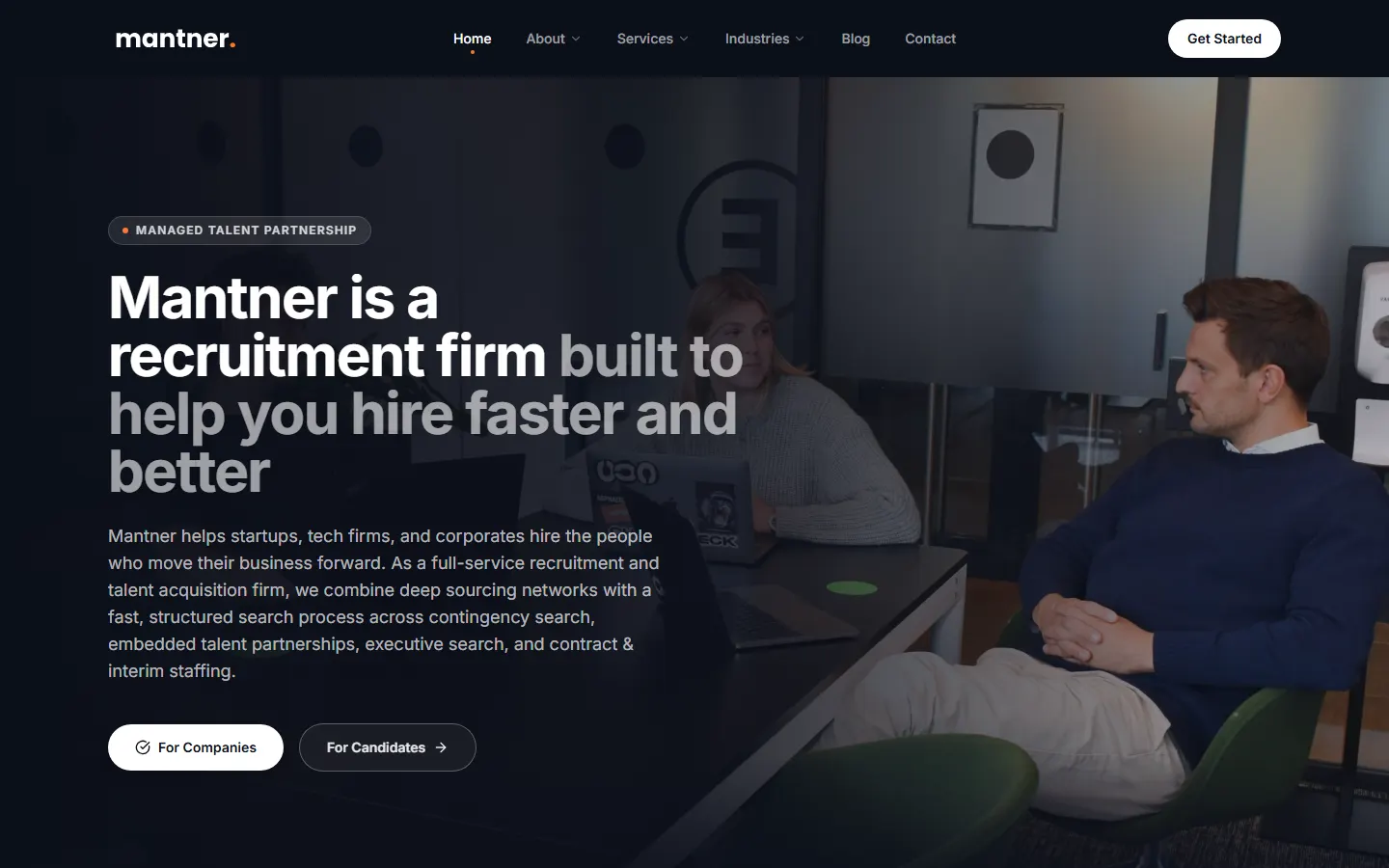 Mantner: a company website for a recruitment firm with clients around the world.
Mantner is a recruitment firm working with startups, tech firms and corporates. Its website explains five services and ten industries, with separate paths for companies and candidates, so each visitor finds the right message.
We also run our own tool websites for people in the US, UK, Canada, Europe and the Arab world (see our case studies). People find them on Google every day without paid ads, and that is the same job a business website should do for you.
Get your business online
If you are not sure what your business needs, start small: a fast website with your services, location and a contact button. You can grow it later. Tell us about your business and we will suggest the simplest website that does the job, with a written, fixed quote.
Frequently asked questions
Does a small local business really need a website?
Yes. Even people who live nearby search on Google for opening hours, prices and directions before they visit. A simple website with your services, location and a contact button answers those searches.
Is a Facebook or Instagram page not enough?
Social pages are good for reaching followers, but they rarely appear when people search on Google for a service in their area, and the platform controls your account. A website works alongside social pages and is fully yours.
How much does a business website cost?
It depends on the pages, design and features you need. You also pay every year for the domain and hosting. Share your requirements and you get a written, fixed quote.
How long does it take to get a website?
A small business website usually takes 1–2 weeks once the text and photos are ready. Online stores and larger sites take longer.
Will a website bring customers by itself?
Not on day one. It needs correct titles, a Google Business Profile, real content and reviews. Once these are in place, the website works for you every day, and every social post or message can link to it.